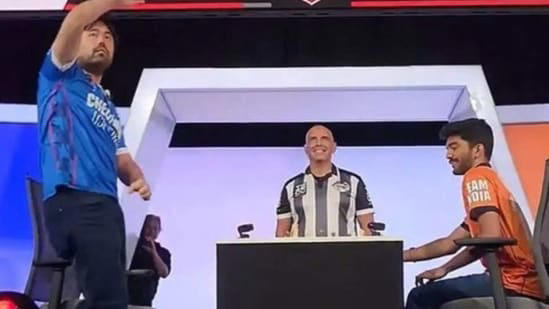
The videos of Hikaru Nakamura crushing the Chess King of Gukesh and throwing it in the spectators gallery at USA-India Checkmate Challenge created a lot of hue and cry. The social media ‘content creators’ made no efforts to find out why the players, and organisers did not disapprove the behaviour of the American. Therefore, I think that it is necessary to come out with the facts.
Chess is an indoor game and does not attract the crowds, in general, due to the slow and quiet nature of the play. Furthermore, nowadays the spectators are not allowed in tournament hall due to ‘Fair Play & Anti Cheating’ regulations.
In order make Chess a public sport, some organisers in the USA planned a ‘Checkmate USA–India challenge’, a tournament with between 5 players of the two strongest Chess playing nations as per FIDE’s norms — 1.USA & 2. India.
Each team would comprise two highly rated male players, one top female player, one junior player and one Chess journalist. It was to be played under ’10 minutes no increment’ time control and the player producing first win on every board would be declared the winner of that board. An overall result of all the five boards would decide the winner.
In order to add thrill and excitement, there was a lot of out of board activity in the tournament hall, including presence of cheer leaders to shout and support their teams. The conclusion was scripted in a peculiar manner to draw media and public attention.
Readers must have seen Tennis players, Cricketers, Athletes and other sportspersons throwing the ball or T-shirts in spectator’s area. The rules of the Checkmate USA-India challenge were similar. The captain of winning team was to crush the enemy king and throw it in spectators’ gallery. The behaviour and actions of players, cheer leaders and spectators, in fact, were as per the script and were pre-approved by FIDE.
Stage was all set for a great show. Though the match was expected to be full of uncertainty over the board, India suffered an unexpected 0–5 loss in the match. Arjun Erigaisi lost to Fabiano Caruana. On the junior board, Ethan Vaz lost the very first game to Adewumi. The women’s board saw Divya Deshmukh going down unexpectedly to Carissa Yip. The Journalists board, too, was a disaster for India, American Levy Rozman scoring over Sagar Shah. Then came the last result, Gukesh allowing a ‘mate in one move’ in a drawn position. A shocking result for India indeed.
As the last game ended, Nakamura threw Gukesh’s King in the spectators gallery, as per the script. The spectators were extremely thrilled and delighted with this novel idea. The organisers turned out be right. The tournament ended with a lot of public attention, with a bang.
Unfortunately, the public stunt, pre-planned by the organisers in their attempt to attract a common sports lover to Chess, was not taken in the right spirit by the Indian sports lovers. Lots of hate messages about Hikaru Nakamura started circulating and despite several clarifications by the players and organisers, the atmosphere continued to be polluted.
However, there is a very serious fact which disturbs me a lot- the poor quality of play by both Gukesh and Nakamura. I am sure that it is a matter of serious concern for both these star players.
Please find the moves of the game hereunder annotated by me from purely Chess point of view.
The readers are advised to see the game on ChessBoard.
1.b4 e6
1…e5 is the more common & most principled continuation. If then 2.Bb2?! Bxb4 and Black is already preferable.
2.Bb2 Nf6 3.a3 d5 4.e3 Bd6 5.c4 0–0 6.Nf3 c6 7.d4 Nbd7 8.Nbd2
Black is on the verge of equalising completely. The standard & classical way of playing this position with Black would be to strike in centre immediately with 8…Qe7 9.Bd3 e5= etc.
However, the World Champion tries to play on the Queen side. 8…a5?!
9.c5 Bc7 10.b5! cxb5
10…Re8 looks risky due to 11.b6 Bb8 12.a4 e5 13.Be2 e4 14.Ng1 Nf8 15.h4 etc. 10…b6? fails to 11.bxc6 Nb8 12.cxb6 Bxb6 13.Bb5
11.Bxb5 b6?
A brave but dangerous way of playing for initiative. Instead of solidifying the Queen side, Black allows a dangerous penetration on his Queen side.
11…Nb8! was safer. The game could go 12.0–0 Nc6 13.Rb1! Bd7 14.a4 Qe7 15.Ne5 Nxe5 16.dxe5 Ne8 17.Bxd7 Qxd7 18.Bd4 etc.
12.c6! Nb8 13.a4! Na6 14.0–0 Nb4!?
An interesting way to seize initiative. The solid 14…Bd6 15.Qb3 Nc7 looks like the best way of holding the fort but Black decided to make more ambitious plans.
15.Ne5?!
White starts going haywire. 15.Qe2, the natural Queen move, leaves Black with little counterplay. For example, 15…Ba6 16.Ba3 Qc8 17.Ne5 when Black is in serious difficulties.
15…Bd6 16.Rc1 Ne8 17.Nd3?!
The BN on ‘b4’ is harmless; it was pointless to exchange it with a powerfully placed centralised WN. The WP on ‘c6’ is like a thorn in Black’s position.
White should have initiated an immediate action in the centre with 17.e4! if now 17…dxe4?! 18.Nxe4 Nd5? 19.Nd7! Bf4 20.Rc4 Bxd7 21.cxd7 Nd6 22.Nxd6 Bxd6 23.Qc2 Nc7
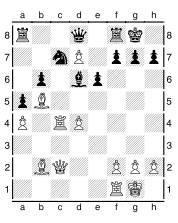
Position after Black’s 23rd move in variation 17.e4
24.Rxc7!! Qxc7 25.Qxc7 Bxc7 26.Ba3 Rfb8 27.g3! f6 28.Rc1 Bd8 29.Bd6 when White has a winning advantage. For example, 29…Rb7? 30.Rc8! Rxd7 31.Bxd7 Rxc8 32.Bxe6+ Kh8 33.Bxc8 etc.
However, after Nakamura’s passive retreat 17.Nd3?!, Black is fine. The game went 17…Nc7 18.Nxb4?
The Indian must be wondering how to activate the QR but the American helps him out. Suddenly Black gets what he was playing for, counterplay on the Queen side!
18…axb4! 19.Bd3?
This is a serious mistake, allowing Black to readily attack the White Pawns on ‘a4’ & ‘c6’, freshly weakened with the exchange of Knights on the previous move.
19.e4! would have led to an even game. 19…dxe4 20.Nxe4= and now if 20…Bxh2+? 21.Kxh2 Qh4+ 22.Kg1 Qxe4 23.d5!! Nxd5 24.Rc4 Qf5 25.Rg4! g6 26.Re1! with a powerful King side attack. 26…Ba6?! 27.Bxa6 Rxa6 28.Rc4! Raa8 29.Re5 Qf6 etc.
19…Ba6! 20.Bxa6 Rxa6 21.e4!
The best option but too late. Black is already much better.
21…Qa8! 22.exd5?
Completely misjudging the position. It was necessary to launch a desperate pawn roller on the King side with either
22.f4! Rxa4 23.f5! exf5 24.Rxf5 24…Ra2! 25.Qc2 g6 26.Rf3 Qa4 etc.
Or 22.e5 Be7 23.f4 g6?! 24.g4 Rxa4 25.f5 Ra2 26.Rc2 Qa4 27.f6 etc.
Now back to the game. 22…Nxd5–+ [Black is winning.] 23.Ne4 Bf4 24.Rc4 Rc8?!
24…Rxa4! 25.g3 Bc7 leaves White without any counterplay.
25.g3 Bb8?
A blunder. Now White has chances to create threats against Black King due to possibility of timely Ng5. Instead, 25…Bh6! 26.Bc1! Bxc1 27.Qxc1 Rc7–+ 28.Nd6 28…Nc3! 29.Qc2 Rxc6 would have clinched the issue.
26.Qc2? [26.Qh5! was the best chance] 26…Rxa4 27.Ng5! g6 28.Rc1 Bd6?!
28…Ra2! , tying down the White Queen, would have won easily. For example, 29.Qe4!? Rxb2 30.Qh4 h5 31.g4 Bf4 32.gxh5 Bxg5 33.Qxg5 Qa3! 34.hxg6 Qf3–+ 35.gxf7+ Kxf7 -+ etc.
29.Qe2? This leads to a losing position again.
29.Qe4! should have been tried, with a possible variation 29….b5 30.R4c2 b3 31.Rc3 Nxc3 32.Rxc3 with counterplay. For example, 32…Rc4? 33.Rxc4 bxc4 34.d5! e5 35.Qh4 h5 36.Ne4 Bc7 37.Nf6+ Kg7 38.Nd7 Qa2! 39.Qf6+ Kg8 40.Nxe5 when we would reach the following position.
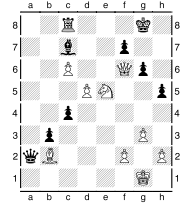
Position after Black’s 40th move in variation 29.Qe4!
After the logical continuation 40…Qb1+ we could reach an extremely complicated position with 41.Kg2 Qf5 42.Nxc4 Qxf6 43.Bxf6
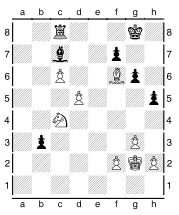
Position after Black’s 43rd move in variation 29.Qe4!
Black has an extremely difficult way to win here, I leave it to the readers to find it out. Let us come back to the actual game.
29…b5! 30.R4c2 b3 31.Rd2 Rxc6 32.Rcd1 Rac4
Black is winning with this move. However 32…Be7! would have put an immediate end to White’s counterplay. The game went
33.Qf3 Qb7 34.Qxb3 Rb4?
34…Bb4! 35.Re2 Bc3!–+ was the simplest way to win.
35.Qf3 Rbc4? [35…Bf8–+ would have led to a win.] 36.Ne4 Be7 37.Nc5! Qc8?
The bold 37…Bxc5! 38.dxc5 R4xc5 was possible as 39.Qe3! fails to 39…f6!–+
38.Nd3 Bd6 39.Nc5 b4 40.Ra1 Bxc5 41.dxc5 R6xc5 42.Rdd1? Rc2–+ 43.Bd4 R5c4
43…Rc6 44.h4 Rc1 was called for.
44.Be5
White’s only chance to create threats lies in the exchange sacrifice Rxd5 followed by Qf6. Therefore Black should have exchanged all the Rooks here with 44….Rc1.
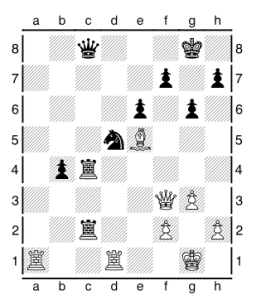
Actual Position which occurred in the game after 44. Be5
44…h5??
A terrible blunder overlooking White’s threat.
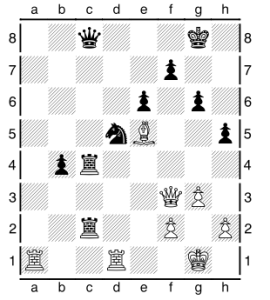
Actual Position which occurred in the game after 44… h5??
45.h4??
White misses a chance to win a piece. 45.Rxd5! Rxf2 (Forced)
- a) 45…Rc1+? 46.Kg2 is resignable for Black.
- b) 45…exd5 46.Qf6! Rc1+ 47.Kg2! wins immediately for White.
46.Kxf2 Rc2+ 47.Kg1 (47.Ke3!! is even stronger but a bit complex.) 47…exd5 48.Qxd5+– was the simplest way to win for White.
45…Qd7
Black plays for a trap. 45…Rc1!–+ would have permanently done away with White’s potential threat of Rxd5. The text prevents the sacrifice for a move. For example, 46.Rxd5?? Qxd5 47.Qf6? Rc1+ when White gets mated first. However, White simply moved his King and renewed his threat of Rxd5.
46.Kh2! 46…Kh7??
A terrible blunder, moving the King from Frying Pan to direct Fire!
46…Rc8! would have prevented the White threats, thereby getting a technically winning position. For example, 47.Rxd5? Qxd5 48.Qf6 Rxf2+! 49.Qxf2 Qxe5 etc.
The move played loses a piece without compensation.
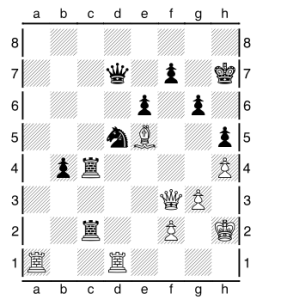
Actual Position which occurred in the game after 46… Kh7??
47.Rxd5!+– exd5 [47…Qxd5?? 48.Qxf7+]
48.Qf6 Rxf2+ 49.Qxf2 Qe6
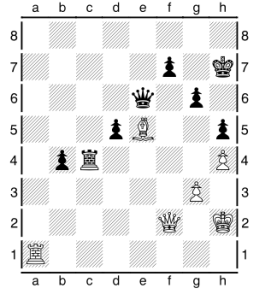
Actual Position which occurred in the game after 49… Qe6
White has won a piece and can easily by retreating the attacked Bishop along the diagonal, thereby keeping the Black Queen tied down to defence. For example, 50.Bb2! ( threatening 51.Ra8) Qf5 51.Qxf5 gxf5 52.Kh3 f4 53.Rd1 fxg3 54.Rxd5.
Objectively strongest was 50.Ra7! launching an immediate attack against BK. The White Bishop is taboo. The game could have gone 50…Kh6 51.Bd4 Rxd4 52.Qxd4 Qe2+ 53.Kg1 Qe1+ 54.Kg2 Qe2+ 55.Qf2 Qe4+ 56.Kh2 when Black has no perpetual check. Now let us see the game continuation.
50.Bf4??
[Moving the Bishop from the long diagonal gives away all the advantage.]
50…b3 51.Rc1??
A terrible blunder allowing Black to win the game with a decisive attack against White King despite material deficit.
51.Re1 (instead of 51.Rc1??) was roughly equal. 51…Qf5 52.Re2 d4 53.Bg5 Qxf2+ 54.Rxf2 d3 55.Rxf7+ Kg8 56.Rf2 Rc2 57.Rxc2 dxc2 58.Bc1 Kf7 59.Kg2 Kf6 60.Kf2 Kf5 61.Kf3 Ke5 62.Ke3 Kf5 63.Kd3 Kg4 64.Bf4
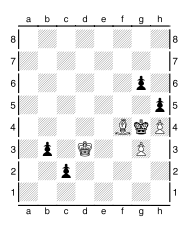
Position after White’s 64th move Bf4 in variation 51.Re1!
64…g5!! 65.hxg5 c1Q! 66.Bxc1 b2!!= 67.Bxb2 Kxg5 68.Ba3 68…Kg4! 69.Bd6 h4 with an obvious draw.
Now back to the game!
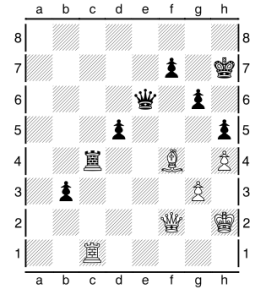
Actual Position which occurred in the game after 51… Rc1??
Here, the World Champion could have won the game with 51…Re4!–+ 52.Kg1 Re2 53.Qa7 b2 54.Rf1 Re1 55.Rxe1 Qxe1+ 56.Kh2 Qe2+ 57.Kh3 Qe6+! 58.Kh2 b1Q
Instead, the Indian chose 51…Rxc1??=
Now it is equal again! The game went
52.Bxc1 Kg8
52…d4! is the most direct way to force a draw. 53.Qxd4 Qe2+ 54.Kh1 Qe1+ 55.Qg1 Qe4+ 56.Qg2 Qe1+ 57.Qg1 Qe4+ 58.Kh2 Qc2+= etc. There followed
53.Bb2 Qe4 54.Qf6 Qc2+ 55.Kh3
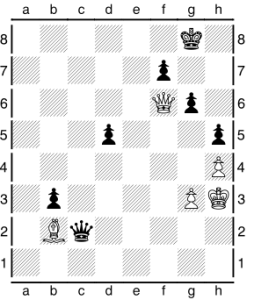
Actual Position which occurred in the game after 55.Kh3
55…Kf8??
An unbelievable blunder, allowing a checkmate in one move!
After 55…Qc8+! Black can force a perpetual check or a favourable exchange of Queens leading to a drawn ending. For example, 56.Kg2 Qc2+ 57.Qf2…Qxf2+ 58.Kxf2 Kf8! 59.Ke3 Ke7 60.Kd4 Ke6 61.Kc5 g5 62.hxg5 Kf5 63.Kxd5 Kxg5 64.Ke4 h4 exchanging the last White Pawn.
55…Qf5+?? was, however, bad as the resulting ending is losing for Black due to poor Pawn structure. 56.Qxf5 gxf5 57.Kg2 etc.
The game went.
56.Qd8#
1–0