
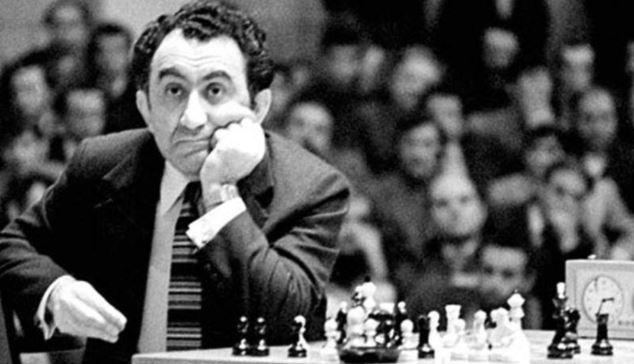
In our series Champion Born On This Date, today we will see the life story of ‘The Iron Tiger’. You guessed it right! He is the 9th official World Champion Tigran Petrosian.
Tigran Petrosian- The Iron Tiger
Tigran Petrosian was orphaned in World War II. He had to sweep streets for making a living and became partially deaf due to exposure to cold weather. Yet he went on to play three consecutive World Championship Matches and Eight Candidates Championships. He was famous for his ‘Positional Exchange Sacrifices’ and was considered ‘The Toughest Player to Beat’. As a result, he earned the nickname ‘Iron Tigran’ which means ‘The Iron Tiger’.
Early Life
Petrosian was born to Armenian parents on 17th June 1929, in Tbilisi (present-day Georgia). As a young boy, he was an excellent student and enjoyed studying. As his father was illiterate, he wanted his son to study more. But, Petrosian started playing Chess from the age of eight.
Though he became an orphan, he continued to play Chess. An ardent Chess lover, he used his rations to buy books on Chess like Chess Praxis by Aron Nimzowitsch and The Art of Sacrifice in Chess by Rudolf Spielmann. At the age of 12 he began training at the Tifilis Palace of Pioneers under the coaching of Archil Ebralidze. Petrosian developed a repertoire of solid positional openings such as the Car0-Kann Defense.
Success Story of Tigran Petrosian
In 1946, Petrosian won the Armenian Chess Championship and the USSR Junior Chess Championship. He moved to Moscow in 1949, to boost his Chess career. He advanced rapidly with an improved results in the tournaments of Soviet Union.
Petrosian was placed second in the 1951 Soviet Championship, thereby earning the title of International Master. Later he earned the title of International Grandmaster after finishing a creditable second in the Stockholm 1952 tournament. Thus, he qualified for the 1953 Candidates Tournament.
Tigran Petrosian finished 5th in his maiden Candidates Tournament and gradually improved his results. In 1962, he qualified for his first World Championship match. against Mikhail Botvinnik. Petrosian won the match with a final score of 5 to 2 with 15 draws, thus, becoming the 9th World Champion.
Tigran Petrosian- The World Champion
In 1966, Petrosian was challenged by Boris Spassky. But, he defended his title successfully. During his World Championship reign, he studied for a degree of Master of Philosophical Science at Yeveren State University. His thesis, dated 1968, was titled ‘Chess Logic, Some Problems of the Logic of Chess Thought’.
At that time, he also campaigned for the publication of a chess newspaper called 64 for the entire Soviet Union, rather than just in Moscow.
However, Petrosian lost his World Championship crown to Boris Spassky in the match held in 1969. But, he remained at the top for another decade, even after losing his crown.
Petrosian died in Moscow on 13th August 1984. At the time of his death, Tigran Petrosian was working on a set of Chess-related lectures and articles to be compiled in a book. Those were later edited by his wife Rona and published posthumously as ‘Petrosian’s Legacy’ in Russian in 1989 and in English in 1990.
In 1987, World Chess Champion Garry Kasparov unveiled a memorial at Petrosian’s grave which depicts the laurel wreath awarded to Chess World Champion and an image contained within a crown of the sun shining above the twin peaks of Mount Ararat – the national symbol of Petrosian’s Armenian homeland.Petrosian was also honoured on the third banknote series of the Armenian Dram with his image on the 2,000 dram banknote.
Learn from the Champion
Today we shall see two games of Tigran Petrosian.
- This game has been praised by several top players of different generations. Though Petrosian preferred to play slow positional games, he did not shy away from accepting the challenges the positions offered.
Tigran Petrosian, V (2640) – Robert James Fischer (2760) [D82]
Candidates Match Buenos Aires (2), 05.10.1971
1.d4 Nf6 2.c4 g6 3.Nc3 d5
Fischer’s favourite opening choice, the Grunfeld Defence.
4.Bf4
4.e3 was the alternative Petrosian preferred in his youth.
4.Bg5 is one of the variations named after Petrosian.
4…Bg7 5.e3 c5 6.dxc5 Qa5 7.Rc1!
7.Qa4+ Qxa4 8.Nxa4 is the boring option several players choose but Petrosian goes for the sharpest alternative.
7…Ne4 8.cxd5
[8.Nge2!?]
8…Nxc3 9.Qd2 Qxa2 10.bxc3 Qa5
10…Qxd2+ was tried in Karpov-Kasparov Match 1986. White stands slightly better.
11.Bc4 Nd7 12.Ne2 [12.Nf3!]
12…Ne5?
[12…Nxc5= was the right way.]
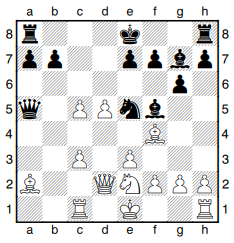
13.Ba2! Bf5?
[13…Qxc5 14.Nd4 was the more solid choice though Black does have some development problems.]
Robert James Fischer
Tigran Petrosian
14.Bxe5! Bxe5 15.Nd4 Qxc5
[Otherwise 16.c6.]
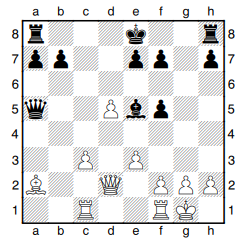
16.Nxf5 gxf5 17.0–0 Qa5!?
Robert James Fischer
 Tigran Petrosian
18.Qc2!
[Again the sharpest! Perhaps Fischer expected the prophylactic 18.g3 for which Black can try 18…h5 19.Qc2 h4 20.Qxf5 Bd6 21.Bb1 Qc7 with counterplay.]
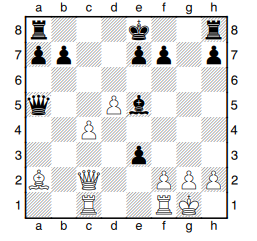
18…f4 19.c4 fxe3?!
[Better was 19…b6]
Robert James Fischer
 Tigran Petrosian
20.c5!!
[20.fxe3 is not so strong as Black is able to block the WB with 20…Qc5]
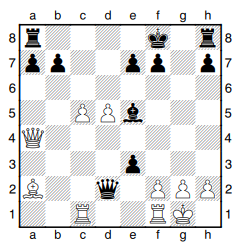
20…Qd2! 21.Qa4+! Kf8
Robert James Fischer
 Tigran Petrosian
22.Rcd1!!
[The only move to keep the advantage.22.fxe3? Rg8 is very dangerous.]
22…Qe2
[Not 22…e2? 23.Rxd2 Bxh2+ 24.Kxh2 exf1Q 25.d6 exd6 26.Qd7+–
Or if22…exf2+ then 23.Rxf2 Qh6(23…Bxh2+ 24.Kf1 Qg5 25.d6)24.d6! f6 25.dxe7+ Kg7 26.Qg4+ Qg6 27.Qe6 Rhg8 28.Rd8! and White wins.
22…Qb2? loses to 23.fxe3 Rg8 24.Rf2 Qc3 25.d6 Qxe3 26.dxe7+ Kg7 27.Bxf7]
23.d6! Qh5
[23…exf2+ loses to24.Rxf2 Bxh2+ 25.Kxh2 Qxf2 26.dxe7+ Kg7
(26…Kxe7 27.Rd7+ Kf828.Qc4+–)
27.Qg4+ Kf6(27…Kh6 28.Rd5)28.Rd3 Kxe7 29.Qd7+ Kf8 30.Qd6+ Kg7 31.Rg3++–
Or if 23…exd6 then 24.fxe3! Qxe3+ 25.Kh1 f6 26.Qd7+–
23…Bxh2+ was inadequate too. 24.Kxh2 Qh5+ 25.Kg1 e2 26.dxe7+ Kg7 27.Qd4+ f6 28.Rd3 exf1Q+(28…Qh1+ 29.Kxh1 exf1Q+ 30.Kh2)
29.Kxf1 Qh1+ 30.Ke2 Qh5+ 31.Kd2 Qh6+ 32.Kc3 Rhe8
(32…Qc1+ 33.Kb3)
33.Rh3! Qg6 34.Rg3]
24.f4 e2
[24…Bf6 loses to25.Rd5 Qg6 26.f5 Qh6 27.Qb3 e2 28.Re1 Qf4 29.dxe7+ Kg7 30.Rxe2 Bd4+ 31.Rxd4 Qxd4+ 32.Kf1 Qf4+ 33.Rf2 Qc1+ 34.Ke2+– etc.]
25.fxe5 exd1Q 26.Rxd1 Qxe5
[26…Kg7 27.Rf1 e6
(27…Qxe5 28.Rxf7+ Kh6 29.Qh4+ Kg6 30.Rxe7+–)
28.Bxe6+–]
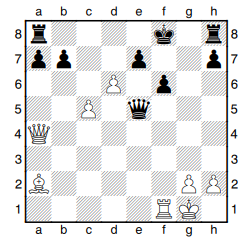
27.Rf1,f6
[27…f5 loses to28.Qb3 Kg7 29.Qf7+ Kh6 30.dxe7+–
27…Qxc5+is no better. 28.Kh1 f6 29.Qb3 Kg7 30.Qf7+ Kh6 31.dxe7]
Robert James Fischer
 Tigran Petrosian
28.Qb3! Kg7
[28…e6 29.Qxb7 Re8 30.c6]
29.Qf7+ Kh6 30.dxe7 f5 31.Rxf5 Qd4+ 32.Kh1 [Black resigned.]1–0
2. This is a little known game by Tigran Petrosian. Here is an example how the future World Champion spotted an inaccuracy in a top game and refuted it against legendary Chess Problem Composer Grigoriev, who paid price for blindly following a past master.
Tigran Petrosian – Nikolay Dmitrievich Grigoriev [B29]
Tbilisi 1945
1.e4 c5 2.Nf3 Nf6
The Nimzowitsch Variation of the Sicilian Defence, a hybrid version of Sicilian Defence & Alekhine’s Defence, has never been taken seriously at top levels.
3.e5 Nd5 4.Nc3 Nxc3 5.dxc3 b6?
A grave blunder, losing the game by force at such an early stage. Black blindly follows a mastergame without giving a serious thought to the moves chosen but he didn’t know that he was dealing with a future World Champion!
Here is the mastergame by the founder of the variation.
Michell, Reginald Pryce – Nimzowitsch, Aron [B29]
Marianske Lazne Masters (12), 02.06.1925
1.e4 c5 2.Nf3 Nf6 3.e5 Nd5 4.Nc3 Nxc3 5.dxc3 b6?? (The Diagram Position) 6.Bd3? Bb7 7.Bf4 Qc7 8.Bg3 e6 9.0–0 Be7 10.Nd2 h5 11.h3 g5 12.Be4 Nc6 13.Re1 0–0–0 14.Nc4 b5 15.Nd6+ Bxd6 16.exd6 Qb6 17.Bf3 g4 18.hxg4 hxg4 19.Bxg4 f5 20.Bf3 Rh7 21.Kf1 e5 22.Bxc6 Qxc6 23.f3 e4 24.fxe4 Rg8 25.Bf2 fxe4 26.Qd2 e3 27.Qxe3 Qxg2+ 28.Ke2 Rf7 29.Kd1 Kb8 30.Rg1 Rxf2 31.Rxg2 Rfxg2 32.b3 Rg1+ 33.Kd2 R8g2+ 34.Kd3 Rxa1 35.Qxc5 Rd1+ 36.Ke3 Re1+ 37.Kd3 Be4+ 38.Kd4 Rd2+ 39.Ke5 Rd5+ 40.Qxd5 Bh1+ 0-1 Black won.
However, Petrosian had his own ideas and plans!

Black has violated the basic norms of King Safety, Activity of Pieces, Centre control & Development. White, therefore immediately seizes the opportunity to launch a decisive offensive against Black.
6.e6!! dxe6
6…fxe6 is unplayable due to severe weakening of the King Position. For example, 7.Ne5! g6
(7…d6? 8.Bb5+! forces resignation.)
8.Qf3 Qc7 9.Qf7+ Kd8 10.Bf4 Bh6! 11.Bg3! Qb7 12.Be2! d5 13.0–0 a6
(13…Nc6 14.Bb5)
14.c4 Nd7 15.cxd5 exd5 16.Rad1 Rf8 17.Qxh7 Nxe5 18.Bxe5 when Black is helpless as 18…Bf4 fails to 19.Qg7!
7.Qxd8+ Kxd8 8.Ne5! Ke8
8…Kc7 loses immediately to 9.Nxf7 Rg8 10.Bf4+ Kc6 11.Bd3+–
9.Bb5+ Bd7
The natural 9…Nd7 loses to 10.Bc6 Rb8 11.Bf4 when Black must play 11…Rb7
10.Nxd7 Nxd7 11.Bf4! e5
The best chance.
11…a6 loses to 12.Bc6 Rc8
(12…Ra7 13.Bb8)
13.Bb7 Kd8 14.0–0–0 Rc7 15.Bxc7+ Kxc7 16.Bxa6
12.0–0–0 f6
12…exf4 fails to 13.Bxd7+ Kd8 14.Bc6+ etc.
12…Rd8 loses to 13.Bxe5 a6 14.Bc6 f6 15.Bc7 when Black loses a full Rook.
The game went 13.Bxd7+ when Black resigned. 1–0