
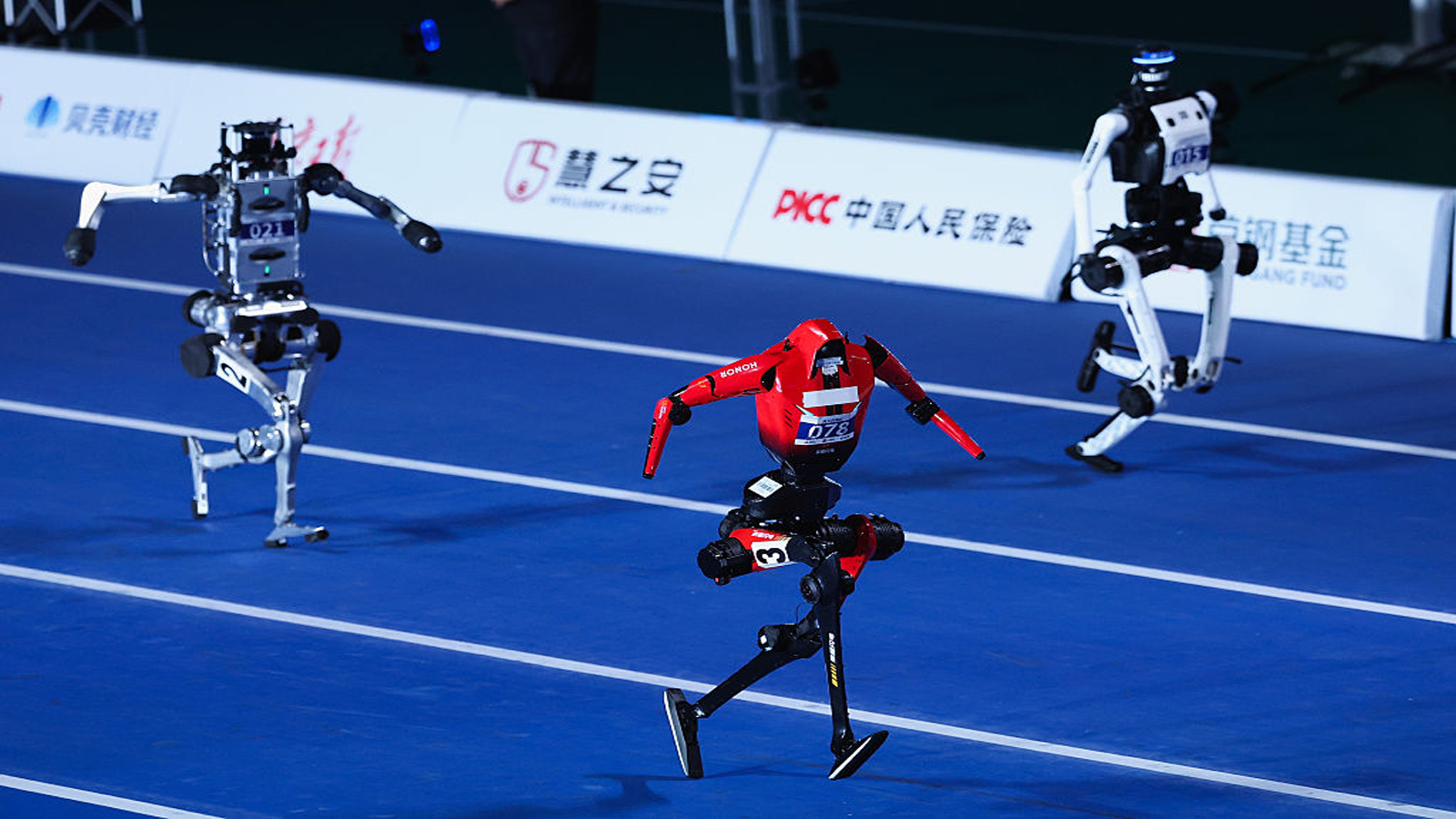
The 2026 World Humanoid Robot Games have transformed sport into a laboratory for artificial intelligence, raising a provocative question: can machines replicate athletic brilliance without ever experiencing the emotions that give sport its meaning?
The sight was almost surreal. At the 2026 World Humanoid Robot Games in Beijing, a humanoid robot named Tiangong Ultra completed the 100 metres in 8.64 seconds, faster than Usain Bolt’s human world record of 9.58 seconds. The achievement was extraordinary, but the aftermath was equally revealing: several robots struggled to stop, with some crashing into barriers.
That juxtaposition captures the paradox of humanoid robotics. Machines can achieve spectacular feats of physical performance while still struggling with something humans perform instinctively.
Held from August 22 to 26, the Games brought together more than 2,000 robots, 666 teams and 51 events. Athletics, football, boxing, table tennis, gymnastics and weightlifting featured alongside tasks designed to simulate industrial, commercial and emergency situations.
The event was therefore much more than a sporting spectacle. It was a technological stress test.
Sport as a robotics laboratory
For robotics companies, sport offers an ideal testing ground. A sprint measures speed and balance; football tests coordination and decision-making; gymnastics demands precision; and contact sports expose the machine’s ability to recover from instability.
More importantly, the Games increasingly test embodied artificial intelligence—the ability of AI not merely to process information but to perceive its surroundings and act within the physical world. That has significant implications for the sports industry.
Humanoid robots could become tireless training partners, capable of reproducing specific movements and tactical situations repeatedly. A footballer could train against an endlessly adaptable robotic defender; a boxer could practise against a machine programmed to replicate an opponent’s style; a goalkeeper could face thousands of precisely calibrated shots.
The implications extend to broadcasting and commercial sport. Robotics manufacturers could become team owners or sponsors, while competitions could evolve into a new genre combining sport, entertainment and technological exhibition.
But can a robot feel?
Tiangong Ultra has reproduced the Boltic movement. But did it reproduce the meaning? This is where technology encounters philosophy.
Bolt’s 9.58 seconds is remembered not simply because of the number. It represents years of training, expectation, pressure, ambition and the possibility of failure. The stopwatch measured the performance of Tiangong Ultra but it could not measure the human struggle behind it.
A robot can recognise a human emotion. It can detect facial expressions, movement patterns and vocal changes. It can even be programmed to imitate celebration, disappointment or frustration.
But imitation is not experience. A machine may lower its head after missing a shot, yet that does not mean it feels disappointment. It may celebrate a goal, but it does not necessarily understand victory. That distinction is fundamental because sport derives much of its power from emotion.
The real impact
The significance of the Humanoid Robot Games, therefore, may lie less in whether robots eventually defeat human athletes and more in how they reshape the sporting ecosystem.
They could revolutionise training, analytics, rehabilitation, officiating and sports entertainment. They could generate vast new streams of performance data and create entirely new competitions.
If a machine can run, jump, compete, adapt to an opponent and make decisions autonomously, is it an athlete in its own right? If robots compete against one another, the rules of fairness, eligibility and performance measurement will have to be rewritten. Governing bodies may eventually confront questions that sound futuristic today: Should machines have separate sporting federations? Should manufacturers be treated like team owners? Can an algorithm be considered a coach, a strategist—or even a competitor?
There is also an economic dimension. Humanoid sport could create a new commercial ecosystem involving robotics companies, AI developers, broadcasters, sponsors and technology platforms. Robot leagues could become entertainment properties in their own right, while sporting venues could double as testing grounds for next-generation robotics.
Yet the most profound disruption may be cultural rather than commercial.
The paradox of imperfection
Sport has always been a celebration of the human body and its limitations. Athletes compete knowing that exhaustion, injury, anxiety and failure are unavoidable. A robot, by contrast, does not possess a biological body that ages, or fears defeat. Its limitations are engineered and potentially upgradeable.
That creates a fundamental distinction. A robot may be able to reproduce the mechanics of sporting excellence, but it cannot yet reproduce the human experience behind it.
The significance of a great sporting moment lies not merely in what happened, but in what it meant to the person who experienced it and to those who witnessed it. A comeback matters because defeat seemed possible. A record matters because someone had to endure years of uncertainty to break it. A championship matters because an athlete has something emotionally invested in winning.
Robots may eventually outperform humans in speed, strength and precision. They may even learn to simulate celebration, disappointment and competitive aggression. But simulation is not sentiment. That may ultimately become sport’s most important dividing line.
Machines may redefine how sport is played. Humans will continue to determine why it matters.