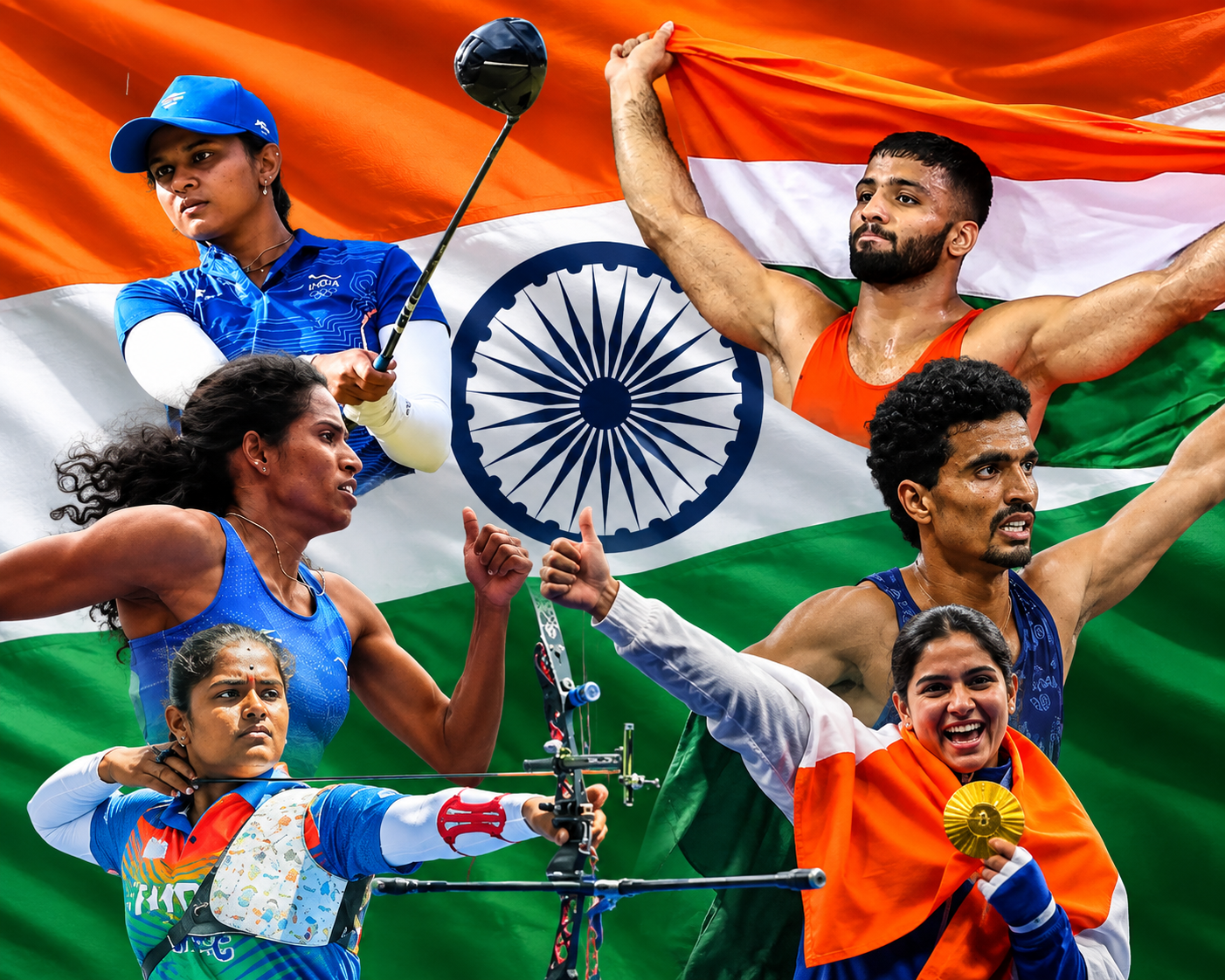
India left the Aichi-Nagoya 2026 Asian Games with 85 medals and fourth place overall. Although the performance was below the record 106 medals won at Hangzhou in 2023, the Japanese Games produced something arguably more valuable- a new generation of performers, several historic breakthroughs and a clearer picture of India’s prospects for Los Angeles 2028.
The 85-medal haul- 21 gold, 27 silver and 37 bronze– at Aichi Nagoya 2026 came across 20 disciplines. Athletics produced the largest number of medals; Shooting provided 15, and Archery led India’s gold-medal charge with 5. Boxing and Wrestling contributed six medals apiece. More importantly, Aichi-Nagoya produced 22 firsts for India, including landmark achievements in Archery, Boxing, Golf, Wrestling, Shooting, Sailing and Hockey.
Kumkum Mohod: India’s brightest new Olympic signal
If Aichi-Nagoya had one breakout star for India, it was 17-year-old Kumkum Mohod.
Making her Asian Games debut, the young archer won three medals — two gold and one silver. She was part of the Women’s Recurve team, along with Ankita Bhakat and Kirti Sharma, that won India’s first-ever Asian Games gold in the event. The Indian team ended South Korea’s 44-year domination and a streak of seven consecutive Asian Games Women’s team titles in the discipline.
Mohod then then delivered the Games’ biggest individual performance by winning the Women’s Individual Recurve title. She became the first Indian woman to win an Individual Recurve gold at the Asian Games by defeating Korea’s Kang Chaeyoung and China’s Zhu Jingyi.
Mohod’s third medal came in the Mixed Recurve team event when she took silver teaming up with Dhiraj Bommadevara. The medals, underline that India’s recurve programme can now challenge the traditional Asian powerhouse on the biggest continental stage.
What does it mean for LA28?
Kumkum Mohod has already helped secure India’s qualification pathway at the LA 2028 Olympics. The challenge now is managing the enormous transition from teenage Asian champion to Olympic contender. Her age works in her favour. Two years of international exposure, world-level competition and Olympic preparation could make her one of India’s most intriguing medal prospects at Los Angeles.
Neeru Dhanda: India’s new Shooting star
Shooting has traditionally been one of India’s strongest Olympic medal-producing sports, and Aichi-Nagoya 2026 provided another name to watch.
Neeru Dhanda returned with three medals- two gold and one silver. She won the Women’s Individual Trap title, partnered Kynan Chenai to win gold in Mixed Trap, and collected a silver in the team event with Aashima Ahlawat and Manisha Keer.
Her individual gold was historic as she became India’s first female individual Asian Games gold medallist in Trap. The mixed-team victory also came with a new Asian record of 34/40 hits. Her performance was so significant that she was chosen as India’s flag-bearer for the closing ceremony.
LA28 prospects
Trap Shooting is an Olympic discipline, but Aichi-Nagoya 2026 medals do not automatically translate into an Olympic quota in the same manner as the specific Archery and Hockey pathways. India will have to navigate the dedicated Shooting qualification system in 2027-28. The Asian Shooting Confederation’s qualification framework includes continental championships in 2027 and 2028.
Gulveer Singh: The distance runner India was waiting for
Perhaps India’s most impressive Athletics story was Gulveer Singh. He won three medals in three distance events– silver in the 10000m and 1500m and bronze in 5000m.
Gulveer’s achievement is particularly important because Indian Athletics has historically struggled to convert strong Asian performances into sustained Olympic-level success in distance running. His three-medal campaign suggests that India may have a genuine contender capable of competing across multiple distances.
The LA28 question
The biggest issue is not whether Gulveer can dominate Asia. It is whether he can bridge the enormous gap between Asian-level podium performances and the Olympic final.
Vithya Ramraj: A 42-year-old record falls
Vithya Ramraj produced one of the most emotionally significant performances of the Games. She clocked 54.75 seconds in the Women’s 400m hurdles to win bronze and break PT Usha’s 42-year-old national record of 55.42 seconds, set at the 1984 Los Angeles Olympics.
But that was only one part of her campaign. Ramraj won gold in the Women’s 4x400m Relay and silver in the Mixed 4x400m Relay. She therefore became one of the Indian athletes to win three medals at Aichi-Nagoya 2026.
Her 54.75 seconds is an important marker. But for LA28, the target has to be much bigger than an Asian medal. She needs to move closer to the global elite over the next two seasons, while India’s 4x400m Relay programmes will need consistent international exposure.
Sujeet Kalkal: The comeback that changed Wrestling’s mood
Indian wrestling arrived in Aichi-Nagoya 2026 under considerable scrutiny. However, it left with renewed confidence. The country won six wrestling medals- two gold, two silver and two bronze– its best Asian Games wrestling haul since 1962.
The standout story was Sujeet Kalkal, who won gold in the Men’s 65kg Freestyle category after a dramatic comeback in the final. Sujeet overturned a 2-9 deficit with eight straight points in the final seconds to seal a historic victory. The Indian Olympic Association named him one of India’s two inaugural Aichi-Nagoya MVPs, alongside Kumkum Mohod.
At just 23, Kalkal has time on his side. His challenge now is establishing himself against the world’s best at the World Championships and Olympic qualification events. Asian Games success is an encouraging indicator, but the Olympic 65kg category is one of Wrestling’s deepest.
Aman Sehrawat: A new chapter at 57kg
Aman Sehrawat won India’s first-ever Asian Games gold in the Men’s 57kg Freestyle Wrestling category. His victory is significant because the 57kg category has been a difficult Olympic weight class for India to navigate in recent years.
For Aman, however, LA28 will be about consistency. An Asian Games gold is an excellent starting point; world-level medals and qualification victories will determine whether he can become an Olympic podium threat.
Lovlina Borgohain: Experience meets a new weight category
Lovlina Borgohain became another historic winner. She won gold in the Women’s 75kg category, India’s first Asian Games gold in that weight class.
India’s boxers collectively produced their best Asian Games gold-medal performance, winning three golds and three bronzes. India topped the Boxing medal table.
Lovlina’s Olympic experience, including her Tokyo 2020 bronze, makes her different from several of the younger breakout performers. The major question is whether she can maintain her trajectory through the qualification cycle and arrive at LA28 in peak form. The 2027 World Championships will be particularly important as India begins the formal Olympic qualification push.
Pranavi Urs: India’s new Golf possibility
Indian golf produced a historic result. Pranavi Sharath Urs became the first Indian woman to win Individual Asian Games Golf gold. She subsequently helped India win silver in the Women’s team event alongside Aditi Ashok and Diksha Dagar.
Golf remains a sport in which India has already demonstrated Olympic medal potential, most notably through Aditi Ashok’s near-podium finish in Tokyo. Pranavi’s Aichi-Nagoya 2026 performance expands India’s depth. The challenge will be converting Asian Games success into consistent performances on the global professional circuit.
Hockey: The most important Olympic qualification of the Games
For Indian hockey, Aichi-Nagoya was not simply about medals. It was about Los Angeles. India achieved a historic double- gold in both the Men’s and Women’s categories.
The Men’s team defeated Malaysia 5-1 in the final to retain its title and secure direct qualification for LA28. The Women’s team ended a 44-year wait for Asian Games gold, defeating China 1-0, with Lalremsiami scoring the decisive goal. They too secured direct qualification.
Why it matters?
Qualification removes one major uncertainty. India’s hockey programmes can now plan specifically for LA28 rather than spending the next two years chasing qualification.
The Men’s team has already demonstrated Olympic pedigree, winning bronze in Tokyo 2020 and Paris 2024. The Asian Games title suggests they remain among India’s strongest medal possibilities.
The Women’s team is a different story. The gold is a breakthrough, but the gap between Asian success and an Olympic podium remains considerable.
The wider story: India is becoming deeper
One of the most encouraging aspects of Aichi-Nagoya was that India’s success was not concentrated in just two or three sports.
India’s leading medal-producing sports
| Sport | Gold | Silver | Bronze | Total |
|---|---|---|---|---|
| Athletics | 1 | 9 | 14 | 24 |
| Shooting | 3 | 8 | 4 | 15 |
| Archery | 5 | 2 | 2 | 9 |
| Boxing | 3 | 0 | 3 | 6 |
| Wrestling | 2 | 2 | 2 | 6 |
| Squash | 0 | 2 | 3 | 5 |
| Sailing | 0 | 1 | 2 | 3 |
| Hockey | 2 | 0 | 0 | 2 |
| Cricket | 2 | 0 | 0 | 2 |
| Kabaddi | 2 | 0 | 0 | 2 |
From Aichi-Nagoya 2026 to Los Angeles 2028
Aichi-Nagoya has given Indian sport a useful two-year roadmap. There are established Olympic medal hopes- Hockey, Shooting, Wrestling, Boxing and Archery. There are emerging possibilities like Gulveer Singh, Vithya Ramraj and Pranavi Urs. And there is a teenage phenomenon who could become the face of the next Olympic cycle- Kumkum Mohod.
The most encouraging statistic may ultimately not be India’s 85 medals. It is the fact that 22 different Indian firsts were recorded in Aichi-Nagoya. That suggests Indian sport is expanding beyond its traditional comfort zones.
India did not merely win 85 medals in Japan. It discovered the next group of athletes who could define Indian sport in Los Angeles.