

A couple of days ago, the Chess world suffered a great loss when former FIDE world championship challenger Jan Timman passed away. He was considered to be the ‘strongest player in the west’ for almost two decades after legendary Bobby Fischer.
I am fortunate to have played against Timman in the Chess Olympiad in 1984. In the days of ‘playing on your own’, we had a very interesting battle in the Samisch Variation of Kings Indian Defence. The moves we played have now become the main theory in sub-variation 8.Bd3. Though I was unable to put up a great fight, I learnt a lot about the Samisch variation from this loss.
Jan Timman (14 December 1951–18 February 2026) had a remarkable life & Chess career. Timman’s mother, Anneke, who, as a schoolgirl, was a mathematics student of former world champion Max Euwe, taught Chess to both her sons at a very young age. The elder one, Ton (1946–2014), held the FIDE Master title. The younger one, Jan, proved to be outstanding at chess in his early teens, and at the age of 15, he finished third in the World Junior Championship held in Jerusalem in 1967.
Timman received the titles of International Master & International Grandmaster in 1971 & 1974, respectively. His first notable international success was at Hastings 1973/74, where he shared victory with MikhailTal, Gennady Kuzmin and Leslie Szabo. A spree of victories quickly followed at Sombor 1974 (jointly with Gulko), Netanya 1975, Reykjavik 1976 (with Fridrik Olafsson), Amsterdam IBM 1978, Niksic 1978, Bled/Portoroz 1979.
In 1982, Timman was ranked second in the world, behind only Anatoly Karpov. In the 1980s, he won a number of top tournaments, including Amsterdam IBM in 1981, Wijk aan Zee (1981 & 1985), Linares (1988), the Euwe Memorial (1989), and the 1989 World Cup in Rotterdam. Other major successes included Las Palmas 1981, Mar Del Plata 1982, Bugojno 1984, and Sarajevo 1984. In my opinion, Timman’s greatest success was winning the 2nd IMOPAR (Paris) Rapid Tournament in 1991, a weekend event that attracted a large amount of prize money. In this knock-out format tournament, he defeated Gata Kamsky 1½–½, Anatoly Karpov 2–0, Viswanathan Anand1½–½, and finally the World Champion Garry Kasparov 1½–½ to win the first prize of approximately 75,000 USD. His performance therein was equivalent to an ELO 2950.
Though Timman won the 1985 Interzonal convincingly to qualify for the Candidates Matches (for the first time), he lost his very first match in the Candidates to Artur Yusupov in 1986. However, in the next cycle, after winning the 1987 Interzonal once again, Timman defeated Valery Salov, Lajos Portisch, and Jonathan Speelman, but lost in the final to Anatoly Karpov (Match held in 1990). He reached the finals of the Candidates Matches once again in 1993, with victories over Robert Hubner, Victor Korchnoi &Artur Yusupov, but lost this time to Nigel Short. After Nigel Short and Garry Kasparov refused to play the World Championship match under FIDE, Timman was automatically selected to play the official World Championship organised by FIDE in 1993 against Anatoly Karpov. Timman lost the match by 12½ points to 8½.
Timman represented the Netherlands in 13 Chess Olympiads from 1972 to 2004, playing on the top board on 11 occasions. In 1976, he won the Gold medal for the best individual performance on the top board.
Timman was one of the chief editors of the magazine New In Chess. As I was a regular participant in the Lloyds Bank Masters Chess tournament in the 1980s & 1990s, and also because Timman knew me well personally, I was asked to write on some of these events. I covered the tournaments won by Zurab Azmaiparashviliin 1989 and by Alexei Shirov in 1991.
Garry Kasparov often praised Jan Timman for his immense contributions to Chess as both a Player and a Writer. Timman was a great Problem Composer, too. Many of his ‘Problems’ (or Puzzles as an amateur would call them) have won prizes in Problem Composing Tournaments. Timman’s most famous book, ‘Art of Chess Analysis’, is considered to be one of the best Chess books of all time. The readers of New In Chess will certainly miss his interesting articles for quite a few years to come.
Let us now see a superb composition by Timman, which, in my opinion, is his best artistic creation.
Composed Problem – By Jan Timman
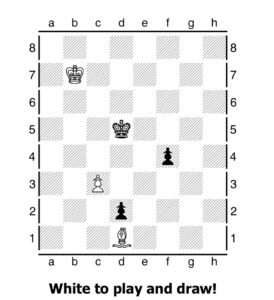
1.Kc8!!
Not 1.Kb6 Ke4 2.c4 f3 3.Bxf3+ Kxf3 4.c5 d1Q 5.c6 Qd8+ 6.Kb7 Qd5! 7.Kb6 Ke4 8.c7 Qa8–+;
1.Kc7 also fails to 1….Ke4 2.c4 f3 3.Bxf3+ Kxf3 4.c5 d1Q 5.c6 Qd5! 6.Kb6 Ke4–+
1…Kc4!
After 1…Ke4, White reaches the same drawn position as in the main variation with 2.c4!! f3 3.Bxf3+! Kxf3 4.c5 d1Q 5.c6!
This is one of the very few positions wherein the Pawn in the sixth rank can force a draw against the mighty Queen! 5…Qd5 6.c7 Ke4 7.Kb8 with an elementary theoretical draw.
2.Kd7! Kd3
2…Kxc3 loses a vital tempo and enables the White King to block the Black Pawns with 3.Ke6 Kd3 4.Kf5 Ke3 5.Kg4= Draw!
3.c4!!
Not 3.Ke6? Ke3 4.c4 f3 5.Bxf3 Kxf3 6.c5 d1Q 7.c6 Qd8–+ Black wins.
3…Ke3
3…Kxc4 allows a simple draw 4.Ke6 Kd3 5.Kf5 Ke3 6.Kg4= Draw.
4.c5 f3 5.Bxf3 Kxf3 6.c6 d1Q+
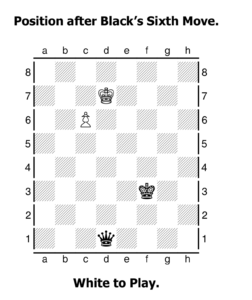
7.Kc8!! Ke4! 8.c7 Kd5 9.Kb8 Qb3+ 10.Ka7 Qa4+ 11.Kb8 Qb5+ 12.Ka7 Qc6 13.Kb8 Qb6+ 14.Ka8!½–½
Let us now see Timman’s most famous and spectacular victory.
Timman,Jan H (2640) – Kasparov,Garry (2700) [C93]
Match Kasparov-Timman +3–1=2 KRO Hilversum (3), 17.12.1985
1.e4 e5 2.Nf3 Nc6 3.Bb5 a6 4.Ba4 Nf6 5.0–0 Be7 6.Re1 b5 7.Bb3 d6 8.c3 0–0 9.h3 Bb7 10.d4 Re8 11.Ng5 Rf8 12.Nf3 Re8 13.Nbd2 Bf8 14.a3 h6 15.Bc2 Nb8 16.b4!
This idea by Grandmasters Alexei Suetin and Paul Keres became extremely popular in the 1970s after Bobby Fischer used a similar setup in the 10th game of the Match of the Century — 1972 World Championship between the defending champion Boris Spassky and the challenger Bobby Fischer.
16…Nbd7 17.Bb2 g6 18.c4 exd4 19.cxb5 axb5 20.Nxd4 c6 21.a4
Still the most popular continuation but21.Bd3! in the style of Anatoly Karpov is a better way to play. After 21…Ne5 22.Bf1 Bg7 23.Rc1 Rc8 24.Rc2! White will succeed in putting pressure against Black’s weaknesses without allowing any counterplay.
21…bxa4 22.Bxa4 Qb6 23.Nc2!
An improvement! A couple of days earlier, Timman tried 23.b5 but failed to get any advantage and even lost the game. 23…cxb5 24.Bxb5 d5 25.Rxa8 Bxa8=
23…Qc7 24.Bb3 Ba6?!
Next year, Anatoly Karpov played the more accurate24…Rxa1 against Timman, and the game ended in a draw after 25.Bxa1 Bg7 26.Ne3 c5 27.bxc5 Nxc5 28.Bxf6 Bxf6 Timman,J-Karpov,A/Bugojno/1986/
25.Rc1!
25.Ra5!, threatening 26.Qa1! & forcing Black to retreat the QB, was also a good option.
25…Bg7 26.Ne3
26.Nd4! was better. 26…c5 27.N4f3 Bb7 28.Qc2 with positional advantage.
26…Bb5 27.Nd5?!
Consistent with the previous move but the whole idea is faulty. Instead, 27.Qc2! Ne5 28.Nec4 would have ensured a slight positional advantage.
27…Nxd5 28.Bxg7 Kxg7 29.exd5 Ne5 30.Ne4?
White embarks on a spectacular but objectively unsound exchange sacrifice. Better options were30.Nc4= and 30.Re3!?30…Nd3 31.Qd2?
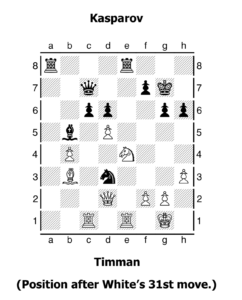
31.Re3 Nxc1 32.Qxc1 Qa7 was better, leading to roughly an equal position.
Here, the world champion misses an opportunity to turn the tables on the opponent. A safeguarding move 31…Qe7!–+ would have ensured the safety of the King’s side without allowing White to save the loss of a Rook for a Knight.
Possible continuations could have been 32.dxc6 Nxc1 33.Qc3+ Qe5 34.Rxc1 Qxc3 35.Nxc3 Bxc6–+ Or 32.Qc3+?! Qe5! etc.
Instead, the world champion played 31…Ra3? which justified White’s speculative sacrifice.
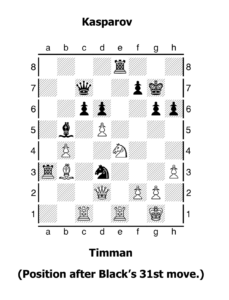
Timman initiated a combination here with the spectacular 32.Nf6!!
Objectively, this spectacular move is not the best. The Rook sacrifice was even stronger.
32.Rxc6!! Bxc6 33.Qxd3 Bb7
(33…Qe7 34.dxc6)
34.Qd4+ Re5 35.f4 Rxb3 36.fxe5 dxe5 37.d6! exd4 38.dxc7 d3!
(38…Rxb4 39.Nd6 Ba6 40.Ra1+–; Or 38…Rb2 39.Nd6 Rxg2+ 40.Kf1 Rc2 41.Nxb7 Rxc7 42.Nc5 are even worse for Black.)
39.Nd6! when Black loses at least the Bishop.
32…Rxe1+ 33.Rxe1 Kxf6 Forced.
33…Qa7?? loses immediately to 34.Ng4!+
34.Qc3+ Ne5!
34…Kg5? loses to 35.Qd4! Ne5
(35…Nxe1? 36.f4+ Kh5 37.Qd1+;Or 35…h5 36.h4+ Kf5 37.Re3!)
36.f4+ Kf6 37.Qb2! Ra8
(37…Qa7+ 38.Kh2)
38.dxc6! Re8
(38…Bxc6 loses to 39.fxe5+ dxe5 40.Rf1+ Or 38…Rf8 fails to 39.Bd5 h5 40.fxe5+ dxe5 41.Qf2+ Kg7 42.Qc5!)
39.fxe5+ Rxe5 40.Rc1 White is in a winning position.
35.f4 Ba4?
Once again, extreme carelessness.With 35…Kg7! Black would have saved the game. For example, 36.fxe5 dxe5 37.Qb2 (Forced) Ra8 38.Rxe5 Qa7+ 39.Kh239…Qc7 40.Kh1 Kh7= with a drawish position.
After 35….Ba4? Timman won the game with brilliant tactics.
36.fxe5+ dxe5
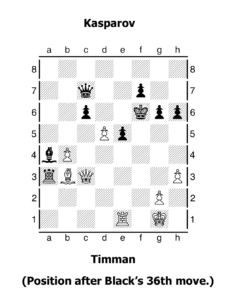
37.d6!!
Not 37.Rf1+?? Kg7 38.d6 Qb6+! 39.Kh2 Bxb3! 40.Qxe5+ Kh7 when Black is a piece up with a perfectly safe King.
37…Qxd6 The alternative37…Qb6+?? fails to 38.Kh2 Qd4 39.Qxd4 exd4 40.d7!
38.Qf3+ Ke7 Or if38…Kg7 then 39.Qxf7+ Kh8 40.Qg8#
39.Qxf7+ Kd8 40.Rd1! Ra1!
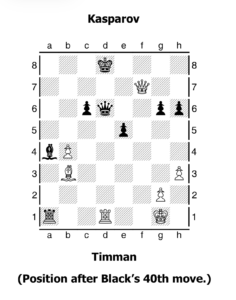
The game went 41.Qf6+!+– when Black resigned.
1–0
Objectively,41.Qf8+! was even stronger!