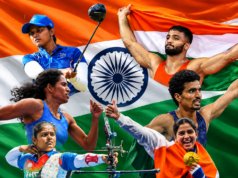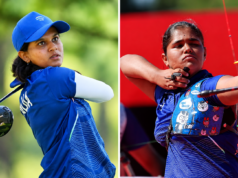
The Asian Games 2026 have opened in Aichi-Nagoya, Japan, with India entering the competition carrying the weight of a record-breaking Hangzhou campaign- and a new generation of athletes looking to expand the country’s medal map.
The Asian Games 2026 have never been merely another multi-sport competition for India. They are, in many ways, part of the country’s sporting history.
India was there at the beginning. The first Asian Games were held in New Delhi in 1951. Seventy-five years later, as the 20th edition of the Asian Games opened in Aichi-Nagoya, India arrived with one of its largest and most diverse contingents, a record 107-medal performance from the previous edition behind it, and an interesting mix of established champions and first-time Asian Games competitors.
The Aichi-Nagoya Games officially opened on September 19, 2026, and will continue until October 4. Japan is hosting the Asian Games for the third time, following Tokyo in 1958 and Hiroshima in 1994.
A ceremony where tradition met technology
The opening ceremony at the Nagoya City Mizuho Park Athletic Stadium was officially declared open by Japanese Emperor Naruhito. The two-hour ceremony brought together Japanese traditional culture, contemporary technology and the industrial identity of Aichi-Nagoya.
The theme was “Harmonic Heart Beat”, with the ceremony built around the idea of different cultures, people and sporting traditions coming together.
One of its most striking visual moments was the appearance of a floating Nagoya Castle, followed by a Kabuki performance by Japanese actor Nakamura Kankuro. Traditional Japanese dance, geisha culture, folklore, lighting and music were combined with references to the region’s extraordinary manufacturing heritage.
The choice of Nagoya is significant. Aichi is one of Japan’s great industrial regions and has strong associations with automobile manufacturing, engineering, aerospace, electronics and traditional craftsmanship. The ceremony therefore attempted to tell the story of the region not simply through sport, but through its identity as a place where tradition and manufacturing innovation coexist.
The cauldron was lit by two generations of Japanese hammer throwers: Koji Murofushi, the Athens 2004 Olympic champion, and his father Shigenobu Murofushi, a five-time Asian Games champion.
Another historic moment came during the parade of athletes. The OCA Refugee Team participated in the Asian Games for the first time, consisting of two Syrian taekwondo athletes living in a refugee camp in Jordan.
The Games feature 45 National Olympic Committees, 43 sports, 71 disciplines and 469 events, with around 11,000 athletes expected according to the Olympic Council of Asia.
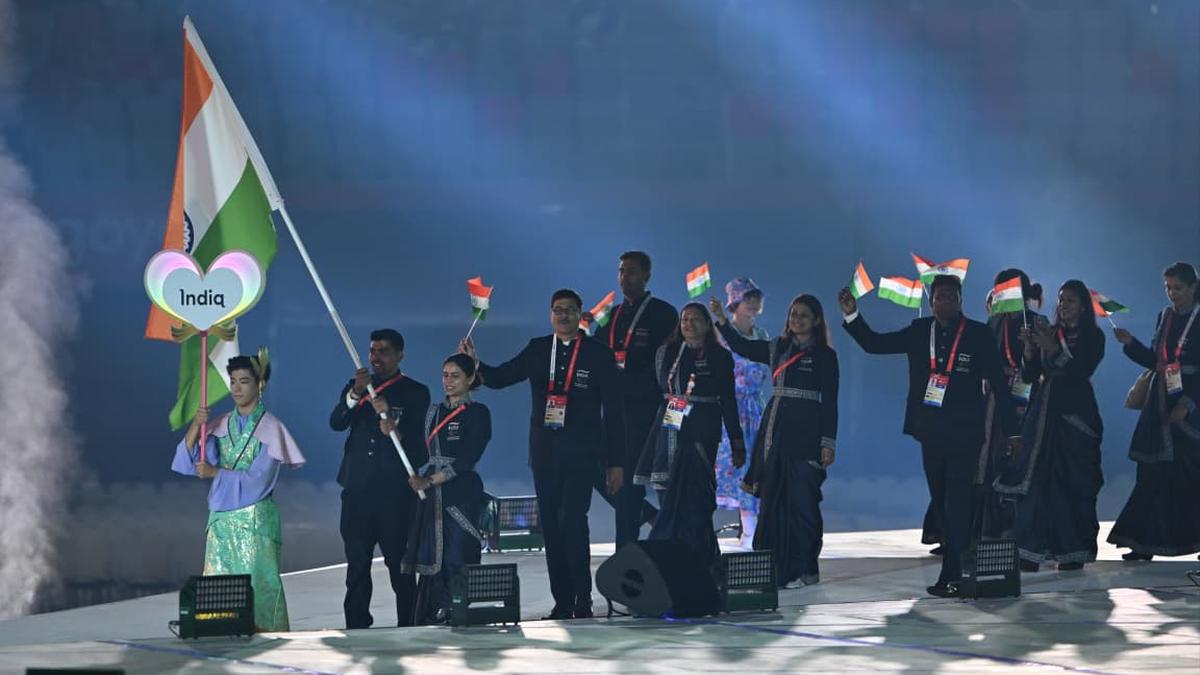
India’s moment: Manu Bhaker and Pawan Sehrawat lead the Tricolour
When the Indian contingent entered the stadium during the opening ceremony of the Asian Games 2026, the spotlight was on two athletes representing two very different sides of India’s sporting story. Manu Bhaker and Pawan Sehrawat carried the Indian flags during the athletes’ parade.
Bhaker needs little introduction. The 24-year-old shooter became the first athlete from independent India to win two medals at a single edition of the Olympic Games when she won two bronze medals at Paris 2024. She is also an Asian Games gold medallist and will compete in the women’s 10m air pistol, women’s 25m pistol and 10m air pistol mixed team events in Aichi-Nagoya.
Pawan Sehrawat represents another distinctly Asian sporting story: Kabaddi. The “Hi-Flyer” was part of India’s gold-medal-winning men’s kabaddi team at the previous Asian Games and now enters the Games as one of the leaders of India’s title defence.
Interestingly, Sehrawat’s appearance as flag-bearer was not originally planned. Tajinderpal Singh Toor, India’s two-time Asian Games champion in shot put, had initially been named the male flag-bearer. But a problem with his ceremonial kit meant that he could not take part in the ceremony. The Indian Olympic Association subsequently replaced him with Sehrawat.
India’s Asian Games story began in Delhi
India played a pioneering role in the creation of the Asian Games movement. The Olympic Council of Asia has described India’s contribution to the establishment of the Asian Games Federation in New Delhi in 1949 and its hosting of the inaugural Games in 1951 as a pioneering contribution to Asian sport.
The first Asian Games were held in New Delhi from March 4 to March 11, 1951. Eleven countries participated, with 489 athletes competing in 12 sports and 57 events. President Rajendra Prasad officially opened the Games at the National Stadium. At the inaugural Games in Delhi, India won 51 medals — 15 gold, 16 silver and 20 bronze — finishing second in the medal table behind Japan. That remains India’s highest overall ranking at an Asian Games.
For decades, India remained a regular but relatively modest medal-winning nation compared with the major Asian sporting powers. That picture has changed considerably in recent editions. India’s 107 medals at Hangzhou 2023 represented its best-ever total medal haul at the Asian Games and included a record 28 gold medals.
That makes Asian Games 2026 more than the 20th edition of a tournament. For India, it is another chapter in a sporting journey that began on home soil 75 years ago. India has sent 503 athletes — 269 men and 234 women — across 36 disciplines. More than 300 of those athletes are making their Asian Games debut, according to the Ministry of Youth Affairs and Sports.